Buying or selling a home in Plymouth? Radon should be on your checklist. Minnesota has some of the highest indoor radon levels in the country, and parts of Hennepin County, including the western suburbs, see elevated readings. You want a clear plan to test, interpret results, and decide on mitigation while meeting Minnesota disclosure rules. This guide gives you practical steps to protect your health and your transaction. Let’s dive in.
Radon risk in Plymouth
Radon is a naturally occurring gas that can build up indoors. About 40% of Minnesota homes test at or above the EPA action level, which makes testing a smart move in every Plymouth home. The Minnesota Department of Health notes elevated risk in parts of Hennepin County, including the western suburbs where Plymouth sits. You should treat radon as a routine part of buying or selling.
The EPA action level is 4.0 pCi/L. MDH recommends mitigating at or above 4.0 pCi/L and considering mitigation between 2.0 and 3.9 pCi/L to reduce risk further. There is no zero-risk level, so lower is better.
- Learn more from the Minnesota Department of Health’s radon overview.
- See local risk context in the MDH press release on Hennepin County.
- Review the EPA action level guidance.
Minnesota Department of Health radon overview | MDH press release on Hennepin County risk | EPA action level
How to test in Plymouth
Short vs. long-term tests
Short-term tests run 2 to 7 days and are common during a real estate transaction. Long-term tests run at least 90 days and give the best estimate of your home’s annual average. For a sale, a licensed professional often uses a continuous radon monitor to produce a time-stamped result.
MDH recommends follow-up based on initial results:
- 0 to 1.9 pCi/L: retest every 2 to 5 years.
- 2.0 to 7.9 pCi/L: follow up with a long-term test.
- 8.0 pCi/L or higher: do an immediate short-term follow-up and consider mitigation.
MDH testing and results guidance
Test conditions and placement
For short-term tests, keep closed-house conditions: windows and exterior doors closed except for normal entry and exit. Place the device on the lowest lived-in level, at breathing height, and away from drafts, heat sources, and exterior walls. Follow the device instructions and MDH guidance closely.
MDH testing and results guidance
Who should test during a sale
In Minnesota, anyone performing radon measurement or mitigation work in a building they do not own or lease must be licensed. For real estate, MDH recommends using a licensed radon measurement professional to provide an independent, defensible result. Ask for a copy of the license and a written report.
Mitigation options and costs
How mitigation works
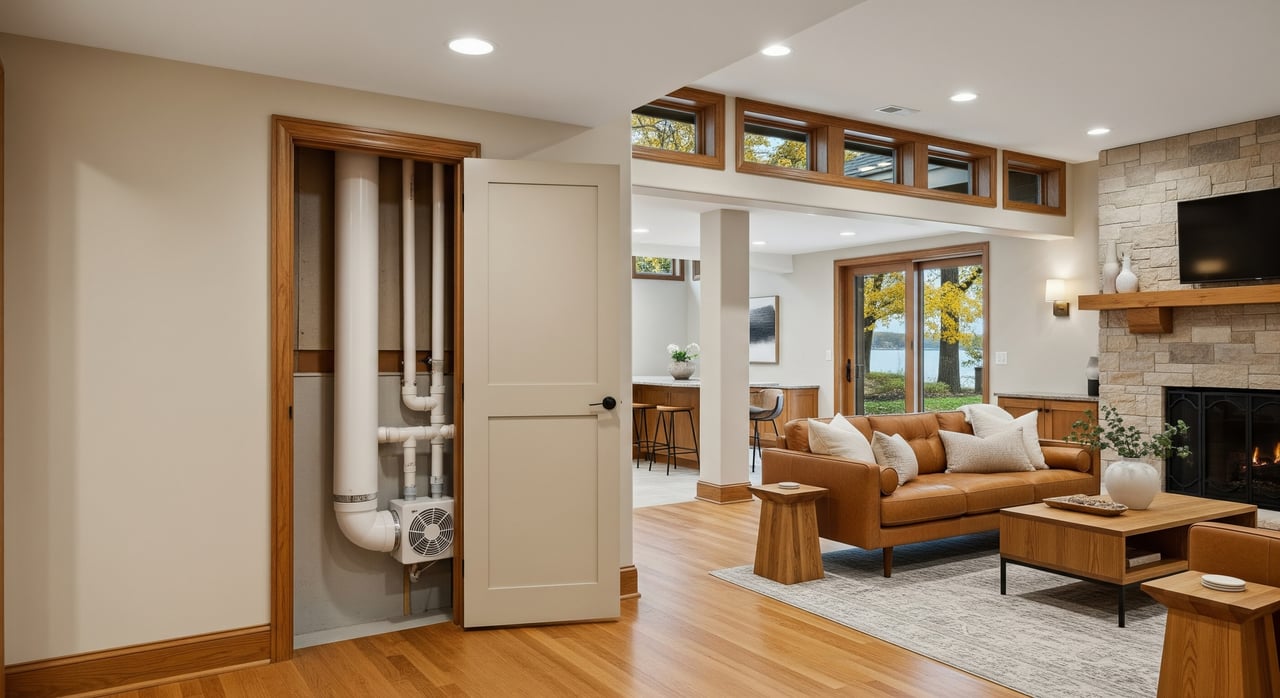
Most homes use sub-slab or sub-membrane depressurization: a suction point under the slab or crawlspace, PVC vent piping, and a fan that exhausts soil gases above the roof. Sealing major cracks is part of the process. Properly designed systems often reduce radon by 50 to 90 percent or more.
Installation steps and quality checks
A professional will assess the foundation, run diagnostics, seal key openings, install the vent and fan, and tag the system. They must provide written operation and maintenance instructions. Retest after installation, allowing at least 24 hours of operation before starting the post-mitigation test.
MDH mitigation system guidance
Licensing, tags, and inspections
Measurement and mitigation professionals in Minnesota must be MDH licensed and follow ANSI/AARST standards. Professionally installed systems require an MDH-issued system tag when completed. MDH offers free inspections of systems installed after June 1, 2020, on request.
Typical costs in Minnesota
Expect about $1,500 to $3,000 for many Minnesota homes, depending on foundation type, size, and complexity. National averages are often near $1,200. Ask multiple MDH-licensed mitigators for written bids. Operating cost is modest, similar to running a 60 to 90 watt fan continuously. Some assistance programs may be available through MDH or local partners.
MDH mitigation system guidance
Minnesota seller disclosures
Under Minnesota Statute §144.496 (Radon Awareness Act), before signing a purchase agreement, a seller must disclose in writing any knowledge of radon in the dwelling and provide the MDH publication “Radon in Real Estate Transactions.” The disclosure must state:
- Whether radon testing has occurred.
- The most current radon records and reports.
- A description of any mitigation performed.
- Information and documentation about any installed system.
- The required radon warning statement.
Buyer protections and remedies
If a seller fails to make required disclosures and had knowledge of material facts about radon, the buyer may bring a civil action. The statute includes a two-year limitations period from closing. Failure to disclose does not automatically void the sale. Keep complete records to protect both parties.
Handling results in a transaction
MDH recommends including radon testing in the inspection contingency and using a licensed measurement professional. If results are elevated, common solutions include seller-paid mitigation before closing, a price adjustment, or a credit so the buyer can mitigate after closing. Put all agreements in writing.
MDH recommendation to test during sales
What records to keep and transfer
Sellers should organize and provide: test reports, system description, MDH system tag with installation date, operation and maintenance instructions, warranties, and post-mitigation test results. Buyers should retain these documents and plan to retest every two years, or sooner after major renovations or HVAC changes.
MDH mitigation system guidance
Simple Plymouth radon plan
For buyers
- Include radon testing in your inspection contingency.
- Hire an MDH-licensed measurement professional.
- Review past test reports and any mitigation documents from the seller.
- Use MDH guidance to interpret results and plan follow-up.
- Negotiate mitigation, credit, or price as needed.
For sellers
- Test before listing or gather recent results and documentation.
- Prepare the required Radon Awareness Act disclosure and MDH brochure for buyers.
- If levels are elevated, get bids from MDH-licensed mitigators and decide on mitigation or credits.
- Keep all records organized for a smooth closing.
If you want a straightforward plan for testing, negotiating, or prepping your Plymouth home, reach out to Jesse James Forsell for local guidance and a smooth transaction.
FAQs
Should I test a Plymouth home for radon before buying?
- Yes, MDH recommends testing all homes and advises including radon testing in your inspection contingency using a licensed professional.
What radon level requires mitigation in Minnesota?
- Mitigate at or above 4.0 pCi/L and consider mitigation between 2.0 and 3.9 pCi/L to reduce risk further.
Who pays for radon testing or mitigation during a Plymouth home sale?
- It is negotiable; buyers often pay for testing and may negotiate seller-paid mitigation, a credit, or a price adjustment if results are elevated.
How much does radon mitigation cost around Plymouth?
- Typical Minnesota systems run about $1,500 to $3,000, with national averages near $1,200, depending on home and system complexity.
What radon documents must Minnesota sellers provide?
- Sellers must disclose testing history, provide the most current reports, describe any mitigation, share system documentation, and include the required warning and MDH brochure.
How long do mitigation systems last and how do I maintain them?
- Fans often last 10 to 15 years; monitor fan operation, follow O&M instructions, and retest every two years or after major changes to the home.